Marketing your pizzeria: how to sell more pizza
People order pizza again and again, together and with something on the side. That makes marketing a pizzeria different from marketing other places, and below is the whole route, from Google to the flyer on the doormat.
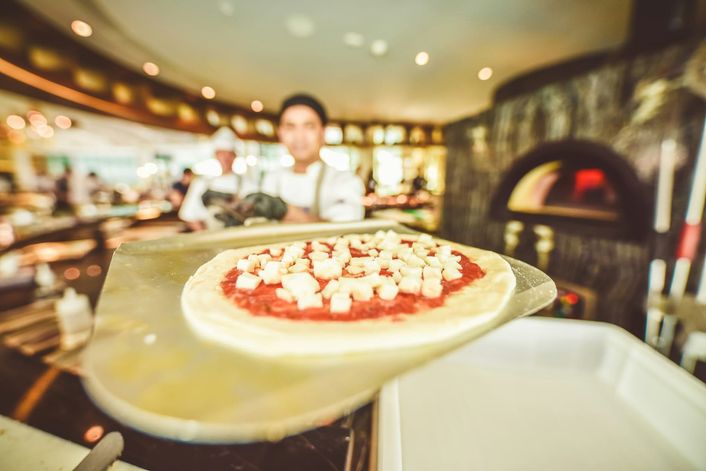
Why pizza needs its own marketing
A pizzeria sells something almost everybody likes and almost everybody has an opinion about. That helps, because nobody needs to be told what it is. It is also your biggest problem. A guest who wants pizza on a Friday evening orders from whichever place comes up first in the search results, or has a deal running that week.
Three traits of pizza decide what works for you.
| Trait | What it means | What you do with it |
|---|---|---|
| Sides belong with it | Garlic bread, chicken wings, a salad, a dessert and a bottle of something cold cost little and earn a lot | Build your menu and ordering page so they land in the basket on their own |
| Pizza gets repeated | People often order the same pizza again, at fixed moments like Friday, Sunday and after training | Make reordering easy and reward it |
| Pizza is for groups | A family, a team or an office orders six pizzas at once | Build packages and go looking for groups |
A fourth trait is less pleasant: the competition is heavy. Besides the national chains, almost every neighbourhood has somewhere with pizza on the menu, from the Italian pizzeria to the Turkish pizzeria and the snack bar that also bakes pizza.
This guide runs in three blocks. First you make sure people find you and that your ordering page actually orders. Then you earn more from every order, through your menu and your deals. Finally you bring guests back and go after groups: loyalty, email, text messages, the neighbourhood, the match nights and the parties.
Platforms like Thuisbezorgd and Uber Eats stay useful for reaching new guests. This guide is about what you hold in your own hands alongside them: your own ordering page, your own list of guests and your own neighbourhood.
Everything below moves one of those three. Without a starting point you will not know in a month whether a deal worked or whether it was just a busy week.
Your place between the chains and the pizzeria down the road
Chains such as Domino's and New York Pizza win on what you expect from a chain: an app, the same menu in every city, offers that come back every week and advertising on a scale you do not have. You will not beat them on those points, and you do not need to try.
You win on what a chain cannot do without breaking its own rules.
- Dough you make yourself and let rise, or ingredients you buy in the neighbourhood
- A pizza of the month you can change tomorrow
- Knowing a guest by name and knowing what they ordered last week
- Delivering in your own district, fast and with no call centre in between
- An owner who picks up the phone when something goes wrong
Do not only compare yourself with the chain. Your guest often chooses between you and the pizzeria two streets over, and that place makes exactly the same pizzas: margherita, salami, quattro stagioni. The difference is not on the menu. It is in the reason your guest remembers.
One sentence that can only be yours
Finish this sentence: 'With us you get ... that you do not get anywhere else nearby.' What you fill in has to be true and has to be something a guest can taste, see or notice.
- Neapolitan pizzas from a wood-fired oven
- Pizzas until half past eleven on Friday and Saturday
- Dough that has risen for two days
- A fully halal menu, or pizzas with meat from a butcher in the neighbourhood
- A gluten-free base baked in its own oven
- Delivery within two kilometres, so the pizza arrives hot
If your sentence fits the place down the road as well, it is not positioning. 'Fresh ingredients' and 'the best pizza in town' fit everybody, so nobody remembers them. The article on slogans has examples for pizzerias too, with what works and what to leave out.
Put that sentence wherever your guest meets you: at the top of your Google profile, on the first line of your ordering page, in your Instagram bio and on the pizza box. If every channel says something different, nobody remembers anything.
Price is not positioning. Whoever fights a chain on price loses on purchasing and on scale. Work out your prices, look at what the place down the road charges as a comparison, and do not start a price war you cannot win.
Being found: your Google profile and the words people search
Pizza is often a spur-of-the-moment choice. People who want pizza rarely type your name. They type 'order pizza', 'pizzeria near me' or 'pizza delivery' with their district behind it, and pick from whatever Google shows them. The block with the map and the three places at the top is the most important piece of the internet for a pizzeria.
You get into that block with your Google Business Profile. How to set it up step by step is in the guide to your Google profile, and local SEO in eight steps shows what comes after. Here is only what is different for a pizzeria.
- Category: pick Pizzeria as the main one and add pickup and delivery if Google offers them as extra categories
- Opening hours: include the late hours, and adjust them for public holidays and the days you close
- Photos: your bestsellers from above, a photo of the oven, a photo of the box as it arrives, and a few new ones every month
- Buttons: point order and menu at your own ordering page and not at a pdf
- Dishes: fill in your top dishes with photo and price, so they can be seen in the profile itself
- Posts: put this week's deal in, because the profile is also a shop window
What people search for
People search in three ways. They search for what you are: 'pizzeria Utrecht'. They search for what they want: 'pizza delivery' or 'pizza pickup'. And they search for what they want to eat: 'salami pizza', 'Neapolitan pizza' or 'quattro formaggi pizza'. You do not have to guess. Type the search terms in yourself, see who comes up above you and which words that place uses.
Put your town and the kind of pizzeria you are in the headline of your home page and in the first paragraph below it. Name the pizzas people search for. Write it as a normal sentence for a guest and not as a row of keywords, because stacked terms read badly, to Google and to your guest.
If you want to be found for 'best pizza' with your town behind it, proving it helps more than repeating the phrase ten times. Reviews, a list of your bestsellers and a photo of your oven say it better. And do not write 'the best' on your page if you cannot back it up.
The same details everywhere
Name, address and phone number have to read the same everywhere. Search engines compare what they find about you in different places. If it all matches, it is clear to them and to your guest that this is one business. If your name is spelled differently somewhere, or an old number from before you moved is still out there, they lose the thread.
Do this properly once and look at it twice a year. It takes an afternoon and it keeps working for years.
Deals that add up: weekdays, thresholds and one offer that always runs
In a category where plenty of places sell the same thing, a good deal stands out. It gives your guest something to look at and a reason to order now rather than later. Eighteen deals are in the article on promotions that lift your online sales. Here are the five that fit pizza, with the sums.
Work out what a discount costs first
Say an order comes to €30 including VAT. Net that is €27.52. Purchasing and packaging are €9.50, so you keep €18.02. What happens to that €18.02 when you give a discount?
| Discount | Guest pays | Margin left | More orders needed to keep the same margin |
|---|---|---|---|
| None | €30.00 | €18.02 | None |
| 10% | €27.00 | €15.27 | Almost a fifth more |
| 20% | €24.00 | €12.52 | Just over two fifths more |
| 30% | €21.00 | €9.77 | Almost twice as many |
| 50% | €15.00 | €4.26 | Just over four times as many |
A fifth off sounds like a fifth of your profit, but here it is almost a third of your margin. Half price asks for more than four times the orders, and you rarely get those. Work this out for your own average order to see what you can afford to give.
One test for every deal: suppose you get twenty extra orders a day with this offer for the next month. Can your kitchen cope, and do you still make something on them? If not, it is the wrong offer. Never make an offer you would not want people to take.
One offer that always runs
A plain percentage discount is the simplest deal there is. Your guest understands it in a second, you can hand it out without explaining, and it runs on your site, your email, your text messages, your ads and your flyers. Give it to new guests, to guests who have not ordered for a month and as a monthly reward to people who collect points.
Always put an end date on it, within one to four weeks. Without an end date it stops being a deal and becomes your new price, and your guest learns to wait for the discount.
A discount with a threshold
A discount that only starts from a minimum amount pushes the order upwards. It works when the threshold sits just above your average order. If your average is €26, pick a threshold of €32 and offer, say, €3 off, or a small discount on the whole.
Keep the discount at no more than half of what the guest spends extra. Somebody who goes from €26 to €32 spends €6 more and gets €3 back, and you keep the margin on what was added. Send the offer mainly to guests who ordered before and have been quiet for a while. Look in your till or ordering system for the usual gap between two orders at your place, and pick the people who are well past it.
A fixed deal on your quietest day
Look in your numbers for the quietest day. At many places it is the first days of the week, but your own numbers decide. On that day your oven, your staff and your rent are there anyway, so that is where a low price costs least. Make it a fixed deal that comes back every week, with a name of its own. A guest who knows it is Tuesday works out the rest themselves.
| Day | What you want | What fits |
|---|---|---|
| Quiet days | To fill the oven | A fixed low price on one pizza, or a lunch menu |
| Thursday | To announce the weekend | A message to your guests with the deal for Friday |
| Friday and Saturday | More per order | Bundles, group menus and a free side with a large pizza |
| Sunday | Families | A family menu for four |
Do not discount on your busy days. Your guests are there anyway and your kitchen is full. Sell bundles instead, like a group menu or a free side with a large pizza, and on Friday and Saturday nights you can add late deals, within what your licence and your municipality's bylaws allow.
The second pizza at half price
The second pizza at half price is a quarter off the whole amount. Buy one, get one free is half off. For an offer like this, pick a dish with low purchasing costs and high recognition, like a margherita or a salami, and not your most expensive pizza. Somebody who orders two pizzas often adds drinks and a side too, and that is where your margin is.
Paid reach: ads, audiences and retargeting
What you post organically reaches only part of your followers. With a small amount a day you put your best clip in front of people in your delivery area. Take what did well as a post, and run it as an ad. Stories suit that well: they fill the whole screen and look like what you already post. Start with a fixed amount a day for two weeks and look at the number of orders, not at likes. How high the amount is depends on your margin and how fast you want to grow.
Who you reach
First set an area that matches where you deliver, and an age that matches your guests. If that is still too wide, you can aim at interests, for instance pizza or a chain. Meta changes its options regularly, so look at what is in the menu at that moment.
Audiences of your own
You can also build groups of people you have already reached. That is smarter than everybody in town.
| Source | What you do with it | What to watch in the Netherlands |
|---|---|---|
| Visitors to your site | Win back people who looked at your menu but did not order | This works with a pixel. A pixel is a tracker and may only load after the visitor consents |
| Your list of guests | Reach people who already ordered with a deal or a new pizza | Upload only guests who gave consent for marketing |
| Your app | Give users who have not been in for a while a nudge | The same consent, in the app |
| Visits and purchases in the shop | Reach people who came by | This is data about your guests too, so consent applies here as well |
| People who engaged with your page | People who watched your video, visited your profile or saved your post | This stays inside Meta, so it is the simplest group |
Using trackers is bound by rules in the Netherlands. Tracking cookies and pixels need consent in advance, under the Telecommunications Act and the GDPR. So only let your pixel load once somebody has said yes. Your audience gets smaller, but it is a correct one.
Retargeting: somebody who has already visited costs less than somebody new
Getting somebody to your site is expensive; getting somebody back who was already there is cheaper. You choose whom you bring back.
- All visitors: broad, but among those visitors are people who arrived by accident
- Visitors to a particular page: somebody who read your parties page sees your group menu
- Visitors who stayed a long time: the share that spent the most time on your site
- People who filled a basket and did not pay: a deal with a one-day deadline
- Guests who have already ordered: your best group, because they know you
Tell them why they see the ad, in a way that does not unsettle: 'You were almost there', 'Fancy pizza again?' or 'One more time this week'. Add a clear button, like See menu or Order now. Always test one thing at a time, such as the photo, the headline or the button, and let the winning version run. The picture usually does most of the work.
Giveaways, challenges and partnerships
Eating pizza is predictable. A deal people talk about is not. You do not need a big budget for it: what matters is a story your guests pass on.
A challenge the neighbourhood talks about
A pizza chain in New Zealand ran a promotion in 2012 in which guests could order a pizza with an extremely hot sauce on one random slice. Whoever hit that slice knew straight away. International media wrote about it. The strength was in the unpredictability.
What would your version be? It costs you little: some sauce and some advertising.
- A giant pizza you have to finish alone or with two, with a photo of the winners on the wall
- An extra hot pizza with a name of its own and a scoreboard
- A Friday surprise pizza whose guests only see what is on it when they open the box
- A pizza your guests invent, where the winner goes on the menu for a month
Say clearly when something is extremely hot, on the dish and in the shop, do not serve such sauces to children and list the allergens as you would for any other dish. The promotion should make a story, not an argument.
A giveaway in seven steps
A giveaway brings attention and addresses, provided you do it properly.
- Pick a prize you give away only once and that makes an impression, like a pizza a week for a year. Work with 52 pizzas at €4.00 for purchasing and box: that is €208. That is the ceiling, because not everybody redeems everything.
- Pick one photo that goes with the prize: sharp, bright light, the pizza large in the frame. Keep the text on the photo short.
- Write the call. Say who you are speaking to, what there is to win, how to take part and when you choose the winner. Ask for a reply everybody answers differently, like their favourite topping or the strangest combination they know. Do not ask for 'yes' or 'interested', because that looks like spam.
- Schedule the post a few days ahead, so you can set up the rest calmly.
- Let an automatic message sequence, through a chatbot or your account's inbox, ask the entrants whether they want email or texts from you and what their address is. This is a separate question. Entering the giveaway is not consent for advertising.
- Run the post as an ad for people in your delivery area, with an age that fits your guests.
- Draw the winner, message them, and send everybody who consented a consolation prize, like free garlic bread with their first order.
Drawing a winner is, according to the Gaming Authority (Kansspelautoriteit), a promotional game of chance. You do not need a licence for it if people can take part for free, minors have their parents' permission and the prize money stays under €10,000. If a jury picks the best entry, for instance the best photo of your pizza, it is as a rule a prize competition and not a game of chance. More conditions apply than are listed here. Read them on the website of the Kansspelautoriteit and ask if you are unsure. Platforms also have their own rules for giveaways, so read those before you start and put your own terms on a page.
Working with people who already have an audience
Your town has people with an audience that loves food: food bloggers, a cook who makes videos, a sports trainer, a presenter at the regional broadcaster. You can pay them to recommend your pizzeria or to run a giveaway with you. Better is a pizza you invent together that carries their name on your menu.
Plenty of hobby cooks with a large following have never had anything on a real menu. A pizza with their name is worth a lot to them. Look at what you can offer: a share of the profit on their pizza, a fixed fee, or only the honour if you are already a well-known place nearby. Somebody with a lot of followers will usually expect payment.
A partnership where somebody is paid or receives something has to be recognisable as advertising. The Dutch social media advertising code (Reclamecode Social Media) asks that the relationship is stated clearly in the post, even when all they got was a free pizza. Agree that beforehand. You grow along with their audience, and they grow with your name.
Starting close to home: sports clubs, schools, student houses and offices
Pizza is group food, and groups are close by. Every group has one person who orders for the rest. That person has to know you, and needs a reason to order from you again. Give them something back, like points of their own or a free pizza after the fifth group order.
| Group | When they order | What you offer |
|---|---|---|
| Sports clubs | After training, after the match, at tournaments and at the end of the season | A team deal with a fixed price and an agreed time |
| Schools | At the leaving party for the last year of primary school (group 8), a school party or an evening for parents | A package per pupil or per class |
| Student houses | The weekly house dinner, exam week, a birthday | A house box for eight to twelve people |
| Offices | Lunch meetings, Friday afternoon drinks, a deadline | A lunch box ordered in advance, with an invoice |
| New residents | The first week after moving in | A welcome card with a free pizza |
Sports clubs
Football, hockey, korfball, indoor football, tennis: after sport, everybody is hungry. Talk to the youth section or the trainer, and to whoever runs the club canteen, because they sell something too. Offer a team deal: ten pizzas for a fixed price, delivered to the clubhouse at an agreed time. Turn it into a club promotion: for every order with the club code, a euro goes to the club's funds, with a maximum you decide. Sponsorship through a board along the pitch or an advert in the club magazine is possible too, as long as you know what you get for it.
Schools
Talk to the parents' council and to whoever organises the group 8 leaving party or the closing evening of the avondvierdaagse, the evening walking event. A package per class, with a pre-counted number of pizzas and a fixed price, saves that organiser hours. For secondary schools, vocational colleges and universities of applied sciences nearby, a lunch deal fits: a slice and a drink for a fixed amount. Aim your advertising at parents and at the school as an organisation, and be careful with children themselves.
Student houses
Students order often, in groups, and on evenings when your place is otherwise quiet. A house box of four large pizzas and three litres of drink for a fixed price is made for eight to twelve housemates. A student discount on showing a student card works for those who want it. You reach them through the student association and its sub-groups, through the chat groups of houses, and through the introduction weeks at the start of the academic year, when new students do not yet know the area. Only leave flyers at letterboxes where you are welcome; more on that further down.
Offices and business parks
Offices order lunch for a meeting, pizza for Friday afternoon drinks and food when somebody has to work late. Find the person who arranges it, often the office manager or the reception. Offer a lunch box that is ordered before half past ten and arrives at quarter past twelve. Business customers want an invoice with the VAT on it and not only a till receipt: make sure you can produce one. Drop by with a sample box and a card. That is more personal than a mailing, and you do not need a list for it.
New residents
Somebody who has just moved often is not cooking in the first days, because the kitchen things are still in boxes, and does not know the area yet. Whoever reaches them then becomes their regular address. In the Netherlands you do not get a list of new homeowners, but you can see them: the removal van, the sold sign, the handover of a new housing estate. Deliver a welcome card with a free pizza and your name on it. Also ask the estate agent, the removal company or the housing association whether they will put a card in the welcome pack.
Do not put such a card in a letterbox with a Nee/Nee sticker, not even if you deliver it yourself. More on that in the section on flyers. The offer can be generous, because you hand out so few: you reach only new residents and your kitchen does not fill up with free orders. Say a pizza costs you €4.00 in purchasing and a box. If that new guest then orders twice a month for €25, that is €600 in revenue a year. That justifies a free pizza, as long as you keep the number of cards small and keep count.
Match nights and tournaments: the busiest evenings of the year
Football and pizza go together. A night with the Dutch national team, a final or the Klassieker (Ajax against Feyenoord) puts a whole street in front of the television, and nobody feels like cooking. Those are the evenings when orders pile on top of each other within a quarter of an hour, and a place that is not prepared loses half its guests.
The next men's European Championship is Euro 2028 in the United Kingdom and Ireland, from 9 June to 9 July 2028. Whether the Netherlands plays depends on qualifying. The United Kingdom and Ireland are an hour behind the Netherlands, so a match that starts at 20.00 there starts at 21.00 here. Build that into your planning. Between tournaments there are evenings enough: the Champions League, the Klassieker, the Eurovision Song Contest, Sinterklaas evening and New Year's Eve.
A match menu that is ready to go
Make a box you can put together and sell in advance, for instance two large pizzas, chicken wings and a big bottle of soft drink for a fixed price. A fixed box is quicker to make than an order with fifteen choices, and your guest does not have to think. Allow pre-orders with a time slot, so the pressure does not all land in the last quarter of an hour.
Work out your capacity. Say your oven can put out six pizzas every quarter of an hour and the match starts at 21.00. You want everything delivered by 20.45 at the latest, so nobody misses the first minutes. If you start at 19.00, that is seven quarters of an hour and so 42 pizzas. Set a maximum per quarter-hour slot in your ordering system. A guest who sees 'sorry, full' gets their pizza somewhere else. A guest still waiting at a quarter past nine never orders again.
Cafés and canteens without a kitchen
Many sports cafés and club canteens have no kitchen but do have a room full of hungry people. They are a business customer: one big order in advance, at an agreed time, for instance twenty pizzas at half time. Call or drop by well before the tournament starts, and offer a fixed price and a fixed time.
Do not use the official names and logos of a tournament in your advertising. They are usually protected. Your own words, like 'match night' and 'the football box', are safer.
Loyalty, email and text messages: bring guests back
People eat pizza from all sorts of places. Even when you make the best pizza nearby, they do not choose you every time. A loyalty programme takes the choice out of the moment: every order brings the guest closer to something free. The forms, the sums and the pitfalls are in the article on loyalty programmes.
What a pizza loyalty programme needs
- Rewards worth having: a welcome bonus, points on every order and a reward at a milestone, like garlic bread after the third and a free medium pizza after the tenth order
- Regular contact: let guests know how many points they have, for instance with 'You have saved 160 points since your last order', and add a link to where they can redeem them
- A simple set-up: no card that gets lost, but a balance that shows on the phone at the moment the guest orders
This works best in the place where the order comes in, on your own ordering page, because that is where your guest's details are and the balance sits next to the pizza.
Consent first
According to the Dutch government, companies may not send messages to people who have not given consent beforehand. An exception applies to a customer who left their email address with a purchase to receive advertising, for similar products, provided they can unsubscribe free of charge every time. The safest route is simple: a tickbox at checkout that is not ticked in advance, a clear sentence about what you send, and an unsubscribe link in every message. The consumer authority ACM supervises this and can impose fines.
Pre-recorded phone messages, even when they land on voicemail without the phone ringing, most likely fall under the same consent rule as email and text. For a pizzeria a text message or an email with consent is the simpler way.
What you send and how often
One message a month with an offer is a good start for text. By email you can send more often, but every email needs something to offer. Test two versions against each other, for instance a discount from a minimum amount against a free side, and choose what wins in your numbers. What works for somebody else does not necessarily work for your guests.
Keep the message short: your name, the offer and how to get it, in one or two sentences, the way you would say it to somebody at the counter. Send it late in the afternoon, when people are deciding what to eat that evening. Make sure whoever answers the phone knows the message has just gone out, because some guests ring back instead of ordering.
The best audience for a win-back message is the guest who ordered often but not for a while. Say somebody who ordered four times in three months and has now been quiet for three weeks. Send that guest a discount from €30, with an end date. A discount works best when the guest has already started to drift.
Bringing a friend
Let guests refer each other. Whoever brings a friend gets something, and the friend gets something with their first order: garlic bread or a drink. Give every guest a link or code of their own, so you can see who brought whom. Let the guest invite their friend themselves. Never send an email or text yourself to an address a guest gives you, because that person has not given you consent.
Packaging and inserts: the bag as a billboard
Every order leaves your place in a box and a bag. Somebody looks at it, on the sofa or at the office, at the moment they are hungry. It is the only moment when you can be sure your guest has your material in front of them.
The box itself
A printed box with your name, your address and a code for your ordering page costs more than a white one, but it is advertising your guest carries inside themselves. If you do not have the budget, a sticker with a QR code on the closed box does most of the work. Make sure the box also looks after the pizza: a box with ventilation keeps the base crisp, and dipping sauce goes in a separate pot, not loose in the box.
What else goes in the bag
- A card with a thank you, a reason to order again and a code you can count
- A flyer for groups and parties, with a phone number and a link
- A short line about your loyalty programme, with how to start and how many points this order earned
On an order that comes in through a platform, that card is the only way to get the guest to you. Put something concrete on it: a dish that is only on your own menu, a first order with something small added, or the points they can collect. The guest decides where to order. You make sure they know there is something to gain at your place.
Change the cards every week or every month, with a code of its own each time. That way you can see which card worked best and which message sticks. Also check your own bag before you hand it over: is the order right, is everything hot, is the sauce in there? One small thing going wrong undoes the whole card.
Flyers and letterboxes: who, what and how
A flyer on the doormat reaches people who do not follow you and have never seen you. For a delivery business, where your area is fixed, that is a direct way to reach every door in the neighbourhood. First the rules, then the content.
The stickers on the letterbox
Many letterboxes carry a sticker. A Nee/Nee sticker means no unaddressed advertising and no free local papers. A Nee/Ja sticker means no advertising, but yes to local papers. That is how the Dutch government describes them. Respect them. Whoever has put up a Nee/Nee sticker has clearly said they do not want a flyer, not even from you.
Some municipalities also have the Ja/Ja system. There you may only deliver advertising to households with a Ja/Ja sticker, and a letterbox without a sticker stays empty. Amsterdam was the first, in 2018, and according to the VNG, the association of Dutch municipalities, seventy municipalities had introduced the system by April 2024. So check what applies in your municipality, and ask the company that delivers your flyers. Some municipalities also set conditions for handing out flyers in the street; read the bylaws.
If you still want to reach those households, choose another way: a flyer in the bag with every order, or a card on a noticeboard at a sports club or school. For letterboxes with Nee/Ja, an advert in the free local paper is an option, because that paper does arrive there.
Who, what and how it looks
An old rule of thumb from direct marketing says that roughly forty percent of success comes from whom you reach, forty percent from what you offer and twenty percent from how it looks. It is a rule of thumb and not research, but the order is right.
Whom you reach is set by your delivery area. You know which streets you can deliver to, so cover all the streets inside that and no further. You do not need a list of addresses for that.
What you offer has to be enough to get somebody moving, without losing money. Good options are a free side with a large pizza, a free big bottle of soft drink with an order above an amount, or the second pizza at half price. Choose something that is asked for often and carries a lot of margin. For every offer, ask yourself: what if twenty orders a day come in on this tomorrow? If that would hurt, choose another offer.
How it looks decides how often it gets read. Your guest is not looking for your flyer, so it has to stand out: a bright colour, an unusual shape or a big photo of your pizza. If your photo is not sharp, have a photographer come for an afternoon or use daylight. Or go for big, bold letters. One offer, one message, one clear call, like Order today, Scan and order or Call now.
Measuring what it earned
Give every flyer a code of its own, or a QR code that leads to your ordering page through a link that belongs only to that flyer. Only then do you know what it cost per order. Say you have 3,000 flyers printed and delivered for €300. Thirty orders come in with the code. That is €10 per order. If you keep €14 on an average order, €4 per order is left after the flyer is paid for, before the guest has even ordered a second time. Without a code you cannot see that, and you never find out whether to do it again.
Reviews that bring in orders
People choose a pizzeria they do not know by the stars and by what other guests say. Reviews appear in Google, on the platforms and on social media. You set up the profile they appear in earlier in this article. Here is what counts for a pizzeria.
- Ask at the moment the guest is happy: at pickup at the counter, on the confirmation page of their order, with a direct link to your Google review page
- Put a QR code to that page on a card in the bag or on the box
- Ask everybody, not only the guests you think are pleased
- Reply to every review, the bad ones too, briefly and with your own name
With pizza, complaints are mostly about three things: arrived cold, arrived late, or the wrong order. A good reply acknowledges it, says what you are doing about it and invites the guest to try again. Make sure you really do it: if the same complaint comes back ten times, it is no longer a review but a message about your kitchen or your delivery route.
Keep it honest. According to the ACM, it has been forbidden in the Netherlands since May 2022 for traders to post fake reviews or have them posted. So do not write reviews about yourself, do not have anybody write them in your name and do not buy them. If you reward guests for a review, that has to be clear. Safer is to ask and to thank, and to give nothing back for the review itself.
Parties, family packages and catering
Pizza is made for sharing, and that is a special opportunity. A birthday, a children's party, a street party or a company party is one order for ten or twenty people. How to build catering as a second source of revenue is in the article on catering. Here is the pizza version.
Make a party package with a fixed price, so the organiser has nothing to work out. A good package holds a number of pizzas in mixed flavours, cut into eight, drinks, a side and perhaps a dessert. Say how many people it is for.
As a rule of thumb you can count on half a large pizza per adult and a quarter per child. For twelve adults and six children that is six plus one and a half, so eight pizzas. At €16.50 per large pizza that is €132. An organiser who sees that in advance orders sooner.
Ask for group orders at least a day in advance and put that on your page, so your kitchen is not caught out. For a children's party you can also offer a pizza-baking afternoon: the children make their own pizza and you bake it. Talk to the parents beforehand about allergies, and keep watch at the oven.
Your first ninety days
You do not need to do everything at once. This guide holds more than you will do in a quarter, and that is intended: you pick what fits your place. If you want an order, take this one.
| When | What you do |
|---|---|
| Month 1 | Your Google profile, your details matching everywhere, photos of your bestsellers, an ordering page with a preview of the menu, sizes and sides, and asking for a review every week |
| Month 2 | A fixed deal on your quietest day, one clip a week, a first conversation with a sports club, a school and five offices, and a trial of flyers in one district |
| Month 3 | Loyalty and messages to guests who consented, a small trial of ads and, if the season fits, a match menu |
At the end of every month, look at the three numbers you started with: orders per week, average order value and guests who ordered twice. Put next to them what each deal earned, using the codes. Keep what works, stop what did nothing and scale up what proves worth it.
A lot of what you read here costs time and little money. That is the good side of pizza: your product is easy to talk about, your guest wants it again, and you can nearly always just try it.
Common questions
- How can a small pizzeria stand out next to chains like Domino's?
- Not on price. Pick one thing your guest can taste or notice that a chain cannot match: your dough, your ingredients, your speed in the district, your late hours or an owner who picks up. Say it in one sentence and repeat it on your Google profile, your ordering page and your box. Then make sure your guests find you again when they are hungry, with a loyalty programme and a message they have agreed to.
- May I send advertising to guests who once ordered from me?
- According to the Dutch government you need consent in advance, except for a customer who left their address with a purchase for advertising about similar products. Every message must contain a free way to unsubscribe. In practice you simply ask for consent with a box that is not ticked in advance, record when somebody said yes and process an unsubscribe the same day. If in doubt, put your set-up in front of a lawyer or look at the ACM website.
- How much discount can I give without losing money?
- That depends on your margin per order, and you work it out yourself: the price without VAT, minus purchasing and packaging. In the example above, a fifth off costs almost a third of your margin, so you need just over two fifths more orders to keep the same amount. Start small, pick a threshold above your average order, put an end date on it and check afterwards whether your order value or your number of orders really went up.
- What do I do about letterboxes with a Nee/Nee sticker?
- Respect them. A Nee/Nee sticker means no unaddressed advertising and no free local papers; a Nee/Ja sticker means no advertising but yes to the local papers. In municipalities with a Ja/Ja system you may only deliver to people with a Ja/Ja sticker. Reach those households another way: a card in the bag, an advert in the free local paper or an offer through a sports club, school or office.
- I only have an hour a week for marketing. Where do I start?
- Start with your Google profile and your photos, because you do that once and it works for years. Then spend your weekly hour on three things: one clip of a pizza coming out of the oven, one fixed deal on your quietest day and asking guests who have just ordered for a review. Once a month, write down your three basic numbers. That is enough to see whether it works.



Social: pizza was made to be filmed
Few dishes photograph as well as pizza. The dough spinning in the air, the cheese stretching, the slice coming loose from the box, the fire in the oven. You do not need a film crew: a phone, good light and ten seconds will do. What to write underneath and how often to post is in the article on what to put on Instagram. Here is what suits pizza.
Photos that make mouths water
Shoot in daylight and watch for glare. Check what is behind the pizza: move the napkin holder and the ketchup bottle aside so the background is clean. A whole pizza is shot from above. A slice being lifted with the cheese still attached to the rest is shot at an angle from the side. That is the photo that stops thumbs.
An editing app gets more out of a flat photo. Raise brightness, contrast, saturation and warmth a little, and stop before the cheese turns orange. Start small and look at the result on your phone in daylight.
Video: five shots you can make every week
Keep each shot between five and fifteen seconds and film upright. Shoot them in one session a week, ten at a time, and post them spread over the days after. Put the same clip on Instagram, TikTok and Facebook; you do not need to make three. A clip of a pizza coming out of the oven does not have to be well edited to work.
Tags and hashtags
Tag your location on every post. Guests searching nearby find you that way. Tag guests only when it fits and only with their permission. A photo with a guest clearly recognisable goes up only after they said yes; for children you ask the parents. If you want to share a guest's photo, ask permission and name them.
Use a mix of hashtags. Only #pizza drowns among millions of posts, and a tag nobody uses finds nobody. Combine general tags like #pizzatime and #pizzaliefhebber with local ones, like #pizza or #eten followed by the name of your town or district. A handful per post is enough. On stories you can shrink hashtags and location and hide them behind text or a sticker: they count and the picture stays clean.
When to post
General lists of the best times to post are a starting point. What counts is when your own followers are online. You can see that in the insights of your business Instagram account, under your audience, by hour and by day. For a pizzeria it is often around the time people decide what to eat, but look at your own numbers. With a scheduler, like the one in Meta Business Suite, you set posts up in advance.
Three times a week beats every day for two weeks and then nothing. Vary the tone: a short joke, a longer story about your dough, a thank you to your regulars. Put the link to your ordering page in your bio and in every story where it fits.