Reading delivery data without fooling yourself
Almost every figure you read about food delivery was measured in America. That does not make it worthless, but you cannot lay it straight over your own restaurant.
The numbers you read were measured in America
Search for food delivery statistics and you land on the same handful of sources: research from American delivery platforms, American consultancies and American market research firms. Those numbers describe a market with different eating habits, different distances and different contracts between restaurant and platform.
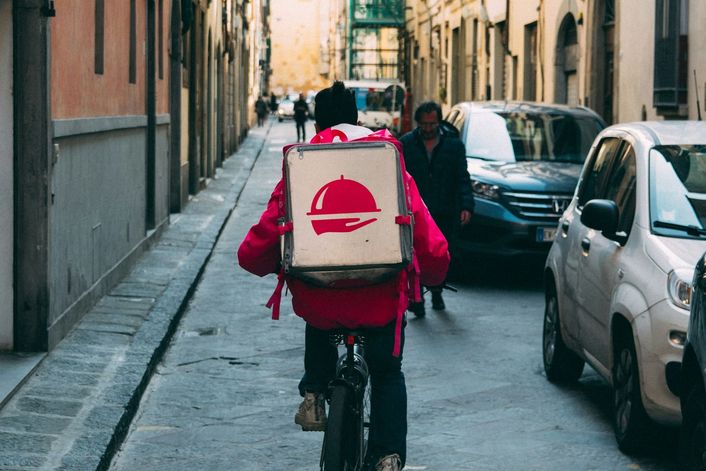
Delivery is not new here either. Twenty years ago you rang the pizzeria or the Chinese place on the corner. The platforms moved that into an app and put a commission in the middle. So an American report describing delivery as a breakthrough is not describing your market.
That does not mean the reports are useless. The direction is worth having, the size is not. That delivery is growing and that people order from a phone is something you will recognise in your own weekly figures. That exactly forty per cent of guests do a particular thing is not a number you can carry across.
Take one statistic you hear repeated and look up the source behind it. The footnote usually tells you exactly what it is worth.
The market is growing, your margin is not
The growth figures are impressive. Research firms expect the global market for online food delivery to keep growing by roughly thirteen per cent a year up to 2030. The number of people ordering food online worldwide passed 1.6 billion in 2023 and is projected to reach around 2.5 billion by 2027. Those are global estimates and forecasts, not Dutch measurements.
More orders is not the same as more profit. Commission is a percentage. Double your orders through a platform and the commission doubles at exactly the same speed. You get a busier kitchen, more packaging, more hours and the same thin margin per order.
Growth is only good news when you decide which channel it arrives through. Otherwise you are building somebody else a bigger business with your own hands.
The growth is in the phone
That people order on a phone is the one part of this data you can use immediately. Your ordering page gets operated with one thumb, standing in the hallway, with the television on in the background. If a guest has to pinch the screen to read your menu, you have lost them before checkout.
Open your own ordering page on your phone tonight and place an order. Count the taps up to payment. More than five is too many.
What is left of a thirty euro order
The figure that actually matters is not in a report, it is on your own statement. Take an order of thirty euros. First 9 per cent btw comes off, because that money was never yours. That leaves 27.52 euros. Only then does the commission arrive.
| Commission | It costs you | Left from 30 euros |
|---|---|---|
| 0 per cent, your own ordering page | 0.00 euros | 27.52 euros |
| 10 per cent | 3.00 euros | 24.52 euros |
| 20 per cent | 6.00 euros | 21.52 euros |
| 30 per cent | 9.00 euros | 18.52 euros |
This table is arithmetic, not a price list. Which percentage applies to you is in your contract, not in this article. It climbs the moment the platform supplies the rider as well, and it varies by package and by period. Look it up on last month’s statement: commission divided by revenue through that channel, and you have your own number.
Packages differ too. Deliver the food yourself and use the platform purely as a shop window and the percentage sits lower than when the platform sends its own rider. Run both versions with your own order numbers before you switch. The difference per order looks small, the difference per month rarely is.
Out of what is left you still have to pay the ingredients, the hours in the kitchen, the packaging and the delivery. Add drinks to the order and the sum changes, because most drinks carry 21 per cent btw. Which is exactly why an order containing nothing but a main course is the thinnest order you can run.
Guests choose convenience, not the platform logo
In American research by Deloitte, around forty per cent of guests said they would rather order straight from the restaurant, against thirteen per cent who preferred a third-party platform. That is American research, so keep the percentage out of your budget. The reason behind it travels perfectly well.
People order from places they already know. They rarely choose an app, they choose the dish they enjoyed last time. The platform is a shortcut, not a decision. Offer a shortcut that is just as quick and the order is yours.
An order on your own page can come out higher too, and not because of a figure in a report but because of who lays the page out. You decide what sits beside the main course, which suggestion appears just before checkout, and which extras exist at all. On a platform the platform decides that, and it keeps a share of whatever the suggestion earns.
- The address and the previous order are already filled in.
- The whole menu is there, including dishes that never fitted on a platform.
- You can suggest an extra or a dessert that genuinely goes with the dish.
- A loyalty balance or saved credit only works on your own channel.
- You keep the email address, so the second order costs you no commission.
A platform also keeps the guest to itself. You see an order and a first name, and rarely an address or email address you are free to use. That is not a detail. If you cannot reach your guests, you have to buy every next order all over again, and buying it back is exactly what commission is.
Never price your own page above the platform. Do check your contract first for what it says about prices.
Your own system knows when the orders come in
American platform data points to Friday around six in the evening as the busiest ordering moment of the week. It sounds plausible, and it is exactly the kind of figure you should never adopt. Dutch mealtimes, your neighbourhood and your menu decide together when your peak sits.
That peak is in your ordering system. Lay the last three months out by day and by half hour and two or three moments will stand out. That is more useful than any report, because it is about your kitchen.
- The moment to send an email or a message, roughly an hour before the peak.
- The moment you need an extra pair of hands in the kitchen.
- The quiet hours, because that is where a promotion actually adds something.
An offer dropped into a rush that was going to happen anyway only costs you margin. The same offer on a dead Tuesday buys you orders that would not otherwise exist.
Delivery is beating the dining room, especially with younger guests
American surveys keep producing the same picture: younger guests order in more often than they eat out, and they use delivery apps far more than older generations do. American figures, but the pattern is probably visible on your own receipts.
What changes for you is mainly where a guest meets you first. That is a phone: the map in Google, a story on Instagram from somebody down the road, or a list inside a delivery app. You have limited grip on that first meeting, and throwing money at it is expensive.
Do not fight for the first order. Make sure the second one comes to you.
The second order is yours to win. A card in the bag with a short reason to order directly next time, a QR code pointing at your own page, a loyalty balance that only counts there. The app introduced the guest, you keep them.
The same phone matters on your own page. Somebody clicking through from a story on Instagram wants to reach the dish they just saw within three taps. So put the dishes you advertise at the top of your menu rather than halfway down, and use the same photograph in both places.
Print a card for the delivery bag this week. One sentence, one code, one address.
What people order, and what survives the ride
The lists of most-ordered delivery dishes you find online come from the annual round-ups of American platforms. Chips, burgers, tacos. Fun to read, and useless as a guide for a menu in the Netherlands.
Your own top ten is useful, and it is sitting in your ordering system. Put that list next to your margin per dish and two things appear at once: which dishes carry your revenue and which mostly create work.
The second question is whether a dish survives the ride. Something that is fine at the table can be a disappointment after twenty minutes in a bag. That does not cost you an order, it costs you a guest, and you only see the difference a month later.
Count the packaging as well. Sturdy containers, a separate sauce pot, cutlery and a bag cost more per order than you think, and in the books they disappear into one large line. Work the cost out per dish once and you can see which dishes really carry your delivery menu.
What you are left with is a delivery menu shorter than your regular one. That is not a loss. A short menu gets chosen faster and cooked faster, and the extras you offer alongside lift the total anyway.
Six numbers that really are about your restaurant
There is no statistic at the end of this article that you can repeat at a party. That is deliberate. The numbers worth having you measure yourself, and they fit on one sheet of paper inside half an hour.
| Number | Where you find it | Why it counts |
|---|---|---|
| Share of orders per channel | Ordering system and platform statement | Shows how dependent you are |
| Average order value per channel | Revenue divided by number of orders | Says whether your own page suggests enough |
| Commission in euros per month | The platform statement | The amount you could win back |
| Share of guests who come back | Ordering system, month by month | Decides whether marketing pays for itself |
| Time from order to doorstep | Your own delivery log | A late delivery costs the next order |
| Cost per delivery | Wages and mileage divided by runs | Says whether delivering yourself adds up |
Measure them for a month, then compare against your own previous month rather than a percentage from an American report. Your own trend is the only honest benchmark you have.
Start on Monday with two: the share of orders per channel and the commission in euros. Together they tell you within a quarter of an hour what there is to win.
Common questions
- How much commission do Thuisbezorgd and Uber Eats charge?
- It varies by contract and by package, and it climbs the moment the platform supplies the rider too. Percentages you find online are often out of date or from another country. Take last month’s statement, divide the commission by the revenue through that channel, and you have the only percentage that describes your restaurant.
- Is delivery even profitable for a small restaurant?
- That depends on what is left per order, not on how many orders you run. Take an average order, subtract the btw, then the commission, then ingredients, packaging and hours. If too little is left, more volume will not fix it. Either the order value has to rise or the commission has to fall.
- Should I leave the delivery platforms altogether?
- Usually not in one move. A platform is a shop window for people who do not know you yet. The problem is not that the first order arrives there, it is that the tenth one does as well. Use the platform to be found and your own page to keep regulars.
- Can I charge higher prices on a platform than on my own site?
- Check your contract first, because some platforms set terms about pricing. Beyond that it is a trade-off. Higher platform prices cover the commission, but a guest who spots the difference remembers it. Plenty of owners therefore keep one price everywhere and make the difference on extras on their own page.
- When is it better to deliver myself?
- Work out your cost per run: the rider’s wages plus the cost of the bike or scooter, divided by the number of runs in those same hours. Put that beside the commission per order. Delivering yourself only wins when you get enough runs per hour and your delivery area stays small. A half-empty evening costs you more than the commission would have.
- Where can I find reliable Dutch delivery figures?
- For the market as a whole, CBS and the trade associations are the places to look. They publish less often than a market research firm, but they measure here. For your own restaurant, your platform statements and the export from your ordering system beat any publication.