What is changing in hospitality, and what to do about it
This is not about what your guests eat. It is about what changes how your restaurant runs: staff, costs, rules, payments and the phone in your guest’s hand. For each change you read what is happening, what it means for you and what you can do on Monday.
What this covers, and who it is for
There are plenty of food trends, and you will find them in this year’s trends. This article is about the changes that alter how your restaurant runs even if your menu stays exactly the same: what the business costs, what you have to arrange and what your guest expects. AI fits none of those three and sits in all of them.
It is about businesses like yours. According to Statistics Netherlands (CBS), there were more than 82,000 hospitality businesses in the Netherlands on 1 October 2026, and in more than 45,000 of them only one person works. You have no purchasing department and no lawyer. You have a phone, an accountant and a few hours a week.
Every figure in this article names its source in the sentence itself. Where a number could not be checked, there is no number.
Staff: less tight, not cheaper
The labour market has loosened. According to CBS, at the end of June 2026 there were 95 open vacancies for every 100 unemployed people across the whole economy, against 91 a quarter earlier. Hospitality barely notices: CBS counted more than 28,000 open hospitality vacancies in the second quarter, almost the same as the 28,400 a year earlier.
Against that stands a cost increase that is fixed. The statutory minimum hourly wage for people aged 21 and over went from €14.40 to €14.71 on 1 January 2026 and to €14.99 on 1 July, reports the Dutch government (Rijksoverheid). It is adjusted every six months. The hospitality collective agreement, the Horeca-cao, runs until 31 December 2026. CBS reports that collectively agreed wages in hospitality rose 2.8 percent in the third quarter of 2026 compared with a year earlier.
Young staff get more expensive
According to the Rijksoverheid, young people aged 16 to 20 will earn more from 1 January 2027: an 18-year-old goes from 50 to 62.5 percent of the adult minimum wage, a 20-year-old from 80 to 87.5 percent. Work it out with today’s minimum wage: €7.50 an hour becomes €9.37. Say that 18-year-old works twenty hours a week. That costs you more than €37 extra a week and nearly €1,950 a year, before holiday pay and employer costs. A snack bar or a pizzeria with young drivers feels that more than a place with a settled team.
What to do about it
Wages and purchasing are your two biggest costs together. In prime cost you work them out as a single number.
- Recalculate your labour cost per hour using the amounts from 1 July 2026 and the wage table of the hospitality collective agreement.
- Lay your rota against your orders, not against your opening hours. An hour in which nobody orders costs you the full wage.
- Remove work no guest ever sees, such as retyping orders from phone or email.
- Keep your people. Someone who stays does not have to be found and trained.
Purchasing, energy and rent are drifting apart
A few years ago almost everything rose at once, which made the sums easy. That is no longer true. The cost lines now each move their own way, so each needs its own answer.
| Line | According to CBS, September 2026 against a year earlier | What it means |
|---|---|---|
| Food in the shops | 1.7 percent lower | The market gives you room. Ask your supplier about it. |
| Electricity, gas and fuels for households | 4.2 percent higher, natural gas 7.4 percent higher | Check when your energy contract ends. |
| Eating out in restaurants and cafés | 3.7 percent higher | Your guest sees your prices rising. |
These are consumer prices from the CBS price index. Your wholesaler charges other prices and a business energy contract has its own rate. The direction still holds: in January 2026 shop prices for food were still 1.5 percent above a year earlier, since May they have been below it, and household energy prices have been above last year’s level since July.
Purchasing
Falling shop prices do not mean your invoice falls. They are a reason to set your five biggest products against a second supplier’s offer once a year, in amounts per kilo or per case.
Energy
Look at your annual statement for what you use and when your contract ends. If you use a lot of energy, the energy-saving obligation may apply to you: according to RVO, the Netherlands Enterprise Agency, you then report every four years which measures you are taking. Whether that covers your business, you can check with the energy-saving checker on rvo.nl.
Rent
There is no national rent figure you can use, because you pay what your contract says. Read how the yearly indexation is arranged. Say your rent is €3,000 a month and is indexed by 3 percent. You then pay €90 more a month, €1,080 a year, without one extra guest coming through the door.
In where your money goes you can lay all your costs side by side in an hour. Why costs you cannot see are one of the five reasons businesses fail, you can read in how many restaurants actually make it.
VAT and tax: what changes and what does not
A lot of rumours circulate about VAT. The fixed points: food and non-alcoholic drinks in hospitality fall under the low rate of 9 percent, alcohol under 21 percent. That has not changed. What did change: on 1 January 2026 the rate on overnight stays went from 9 to 21 percent, reports the trade body KHN. That affects hotels, B&Bs and a restaurant that also lets rooms.
According to the Rijksoverheid, the 2027 Tax Plan contains two VAT measures: the low rate disappears on 1 January 2028 for ornamental plants and flowers and for balloon flights, if parliament agrees. Food and drink are not in it. For your business that means at most dearer flowers on the table.
If you run a sole proprietorship or a general partnership, your own tax counts too. The self-employed deduction is €1,200 in 2026, against €2,470 in 2025, reports KHN, and keeps shrinking in the coming years. What that costs you depends on your income.
Guests order by phone, and the platforms sit in between
The phone has become menu, order slip and wallet. In 2025 CBS asked people in the Netherlands aged 12 and over what they had bought online in the past three months. Nearly 44 percent had ordered meals, more than 72 percent of those aged 25 to 35 and just over 15 percent of those aged 65 to 75. The question was changed in 2025, so do not compare it with earlier years. Some guests will still ring you, but the ordering page has to work on a small screen.
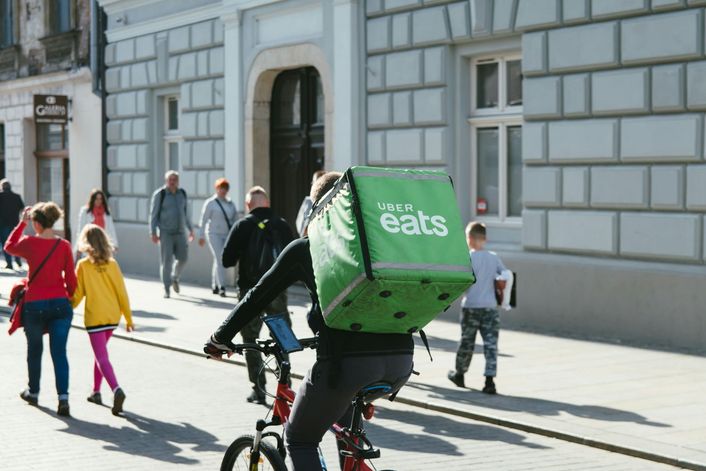
Some of those orders go through platforms such as Thuisbezorgd and Uber Eats. For many guests such an app is a habit: they open it and choose from what is there. That is why a platform brings you new guests, and why you do not walk away from it. How that choice works you can read in why guests order through platforms, and what the well-known delivery figures do and do not say in reading delivery data.
What is changing is the role of your own channel. A guest who has already eaten or ordered with you does not have to find you again among a hundred other places. On your own page they order without a middleman, you know who they are and you can invite them back. The platform brings you reach. Your own channel keeps the relationship.
Guests do the sums too: price and value
Eating out is getting dearer, and your guest sees it. That puts a caveat on the turnover figures. Turnover in places serving food and drink was 3.5 percent higher in the second quarter of 2026 than a year earlier, while according to CBS restaurants and cafés were on average 3.8 to 4.0 percent dearer in April, May and June. Turnover is therefore growing roughly in step with prices, not above them. That suggests the growth comes mainly from higher prices rather than more guests, although neither figure can prove that by itself.
Value is what your guest gets for their money, and they judge it themselves. Someone cooking at home sees that shop prices for food are not rising. In a market like that, value they can see works: a portion that stands out, a dish with a story, a regular who gets something back. Raise prices in small steps, preferably on the dishes where your margin is thinnest. How to work that out is in how to price your menu. Change three dishes, not thirty.
Do not let costs appear only at checkout. An amount that turns up then feels like a surprise, and a surprise is no reason to order. Put the delivery fee, the minimum order and the expected time on the first page. If you send a reminder to someone who did not finish an order, first make sure you are allowed to email that guest.
AI is within reach of small businesses too
For years artificial intelligence was something for big companies. That is changing, more slowly in hospitality than elsewhere. According to CBS, around 7 percent of hospitality businesses with two or more people working in them used at least one AI technology in 2025, against 3 percent a year earlier. Across all businesses in the survey it was 18 percent. These are provisional figures and small numbers, but the direction is clear.
For a business like yours it is mostly writing and number work: a description for a dish, a translation of your menu, a reply to a review, a first draft of your newsletter, a summary of your weekly figures.
Pick one task you do every week and would rather not, try it for a month and measure in hours. If it saves nothing, drop it.
Guest data and the GDPR: more data, more duties
Every order you take yourself produces data: a name, a phone number, an address, sometimes an email address, and what someone ordered. That is personal data, and the General Data Protection Regulation applies, which Dutch law and Dutch suppliers call the AVG. The more guests order directly with you, the more you hold yourself and the more you have to protect.
For a small business the GDPR mostly asks that you know what you keep, why and for how long. Put it on one page.
- Which data you keep and where: till, ordering site, booking system, email programme.
- Why. You keep a delivery address to deliver, an email address to send your newsletter.
- For how long. A delivery address from two years ago no longer belongs in your system.
- Which suppliers you share data with, and whether there is a data processing agreement.
Email and text messages are a second rule. Under article 11.7 of the Dutch Telecommunications Act you may send commercial email and text messages only if you can show the recipient gave consent beforehand. The exception: if you obtained a customer’s address during a sale, you may email them about your own similar products, provided they could object free of charge and easily when the address was collected and in every message. Consent a guest gave to a platform does not cover your messages.
If your email account is hacked or a laptop with your guest list is stolen, you must under the GDPR report it to the Dutch Data Protection Authority (Autoriteit Persoonsgegevens) within 72 hours of discovering it, if it may put the people involved at risk. If you doubt whether it counts, ask your accountant or a lawyer the same day.
Restaurant CRM shows how to turn guest data into repeat visits. Have your set-up checked once by the Autoriteit Persoonsgegevens or a lawyer, because the detail of the rules shifts.
Less cash, more phone at the till
The research Paying at the till, by De Nederlandsche Bank and Betaalvereniging Nederland (the Dutch payments association), published in June 2026, shows that the share of cash payments at the till came to 17 percent in 2025. Card payments made up the other 83 percent, and paying by phone or smartwatch rose from 34 to 39 percent of till payments.
Those are national figures; your own till shows how it stands with you. Pull the payment mix for the last three months and count what cash costs you in change, counting and banking. Whether you keep accepting cash is a choice with costs, and with guests who count on it. Say so in advance, and check the current rules with the Rijksoverheid before you refuse cash altogether.
Online, something changes too. iDEAL is moving into Wero step by step, and since early 2026 guests see the iDEAL | Wero logo. According to Betaalvereniging Nederland all Dutch banks are due to be connected to Wero by October 2026, and banks and payment providers want the switch finished by 31 December 2027 at the latest. Your payment provider handles the technology. Ask when your ordering page moves over and whether the cost per payment changes.
What to do on Monday
You do not have to do everything at once. One morning with your annual figures, your payslips and your phone is enough to see which change reaches you first. Take what costs money first, then what carries risk and only then what offers chances.
| Change | What it touches | First step |
|---|---|---|
| Staff | Labour cost per hour | Recalculate with the wage table |
| Purchasing and energy | Margin and fixed costs | Compare your five biggest products and your energy contract |
| VAT and tax | Till and your own deduction | Put the three questions to your accountant |
| Ordering by phone | Reach and returning guests | Order from yourself once |
| Price and value | What your guest thinks of it | Adjust three dishes |
| AI | Your time | Pick one task and measure for a month |
| Guest data | What you keep and may email | Put what you hold and why on one page |
| Payments | Till and ordering page | Ask when your ordering page moves to Wero |
That is eight conversations, with your accountant, your supplier, your payment provider and yourself. Each takes an hour.
Common questions
- What is the minimum wage in 2026?
- For employees aged 21 and over the statutory minimum hourly wage has been €14.99 gross since 1 July 2026. On 1 January 2026 it was €14.71. The hospitality collective agreement also applies to your staff, with its own wage tables, so working with the minimum wage alone is not enough.
- Is VAT on food and drink going up?
- The 2027 Tax Plan contains no change for food and drink. On 1 January 2026 the rate on overnight stays did go from 9 to 21 percent. Always check the current rate with the Belastingdienst, the Dutch tax authority.
- What is changing with iDEAL?
- iDEAL is moving into Wero step by step. Guests already see the iDEAL | Wero logo, and banks and payment providers want the switch finished by 31 December 2027 at the latest. Your payment provider handles the technology, but ask when your ordering page moves over.
- May I email or text guests who have ordered from me?
- Only with prior consent. The exception covers customers whose address you obtained during a sale: you may email them about your own similar products, provided they can unsubscribe free of charge and easily when the address is collected and in every message. A platform’s consent does not count for you.
- May I use AI for my menu and my replies to reviews?
- Yes, as long as you remain the sender. Read every text back, fill in allergens yourself, do not put guest data into a free tool and never invent reviews.
- Which change do I tackle first?
- The one where the money is: your labour cost per hour and your purchasing. Then your guest data, because a mistake costs most there, and only then AI and payments.